

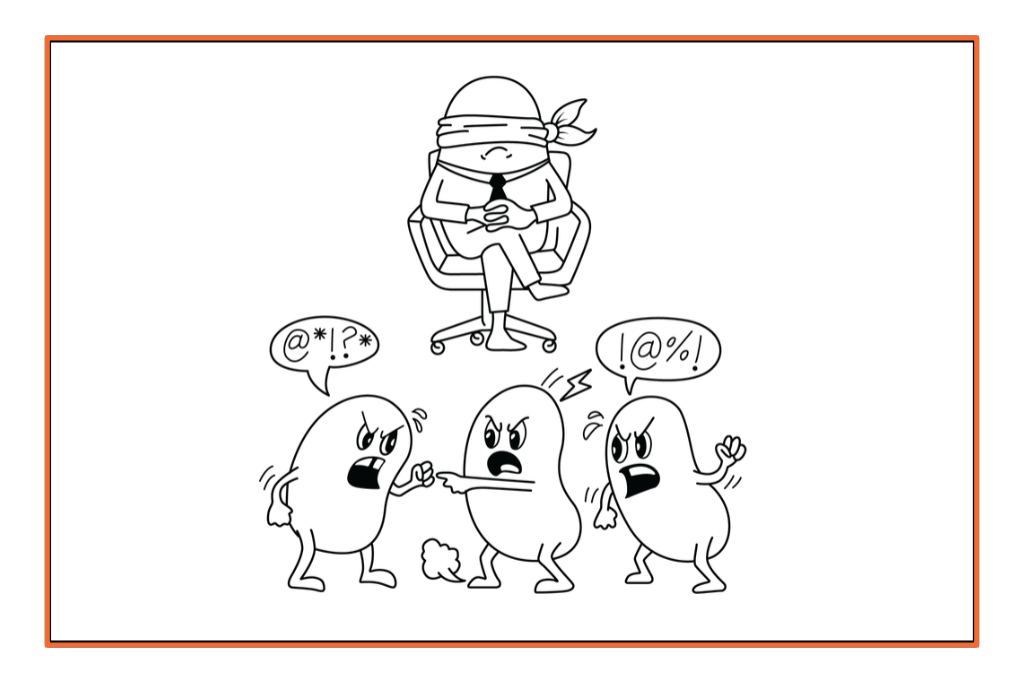
Most leaders say they value collaboration, teamwork, and accountability. But when performance falls short and a difficult conversation is required, those values are put to the test.
Sometimes, instead of addressing the issue directly, leaders rely on three common workarounds that fail: the Feedback Sandwich, the Written Workaround, and Moving the Chess Pieces.
Consider this composite scenario based on a common organizational pattern.
Larry was a director in a large regional nonprofit. Ben, one of his technology specialists, routinely played video games during work hours, hid out, waited to be nudged, and offered excuses instead of solutions.
His lack of initiative affected several departments. Other employees created workarounds to compensate for what wasn’t getting done.
Larry saw the behavior but avoided addressing it.
Eventually, Kim, a senior HR leader, stepped in. But instead of helping Larry prepare for and conduct a performance conversation, Kim drafted a letter transferring Ben to another team.
The letter began:
Your technical contributions have supported several important organizational initiatives.
It continued:
As our operational needs evolve, we are realigning resources to better support the organization.
Then came the real message:
Effective on [date], your position will transition to the central operations team under the direction of [name]. Your responsibilities will expand to include additional systems support.
In one short letter, the organization used three common approaches that do not work.
1. The Feedback Sandwich
The feedback sandwich—sometimes called the S___ sandwich—attempts to cushion an uncomfortable message between two more palatable ones.
Start with praise. Slip in the bad news. End with something positive.
The problem is that the praise often feels insincere and the real issue remains unclear. In this situation, Ben was told that his contributions had supported important initiatives, but he was never told that his performance and behavior were creating problems for other departments.
The sandwich may make the message easier for the leader to deliver, but it doesn’t make the message easier for the employee to understand.
Appeasing and sidestepping create confusion.
Ben thought he was getting a promotion.
2. The Written Workaround
An executive recently said to me, “Leading is so difficult these days because employees use AI to respond to performance issues.”
But AI isn’t the central problem. Conversations about performance should never be reduced to an exchange of carefully composed written statements.
Performance conversations should happen in real time—either face-to-face or by videoconference—with a clear intention and desired outcome.
Email, text, and written documentation all have an appropriate place. Writing can confirm expectations, document agreements, and summarize a conversation.
But written communication should support live dialogue, not replace it when performance, behavior, trust, or emotion is involved.
A letter can’t reveal how the message landed. A text can’t explore the employee’s perspective, test resistance, correct misunderstandings, or invite responsibility.
In this case, the formal letter communicated a decision without addressing the behavior and performance that led to it.
3. Moving the Chess Pieces
When leaders don’t know how to address performance or behavior, they sometimes reorganize. I call this “moving the chess pieces.”
They change reporting relationships, restructure departments, transfer employees, or move responsibilities elsewhere.
The chess pieces move, but the underlying problem remains.
Someone else inherits the unresolved problem, while the leader who is relieved to be rid of it never develops greater leadership capability.
A leader who avoids is still a leader who avoids.
Ben’s transfer didn’t build his initiative or problem-solving ability. It didn’t strengthen Larry’s leadership capacity. It simply moved the consequences of an unresolved problem to another department.
Ironically, the HR executive was often the first person to talk about collaboration, teamwork, and getting the right people on the bus.
Slogans are easy. Conversations require courage.
The Problem Beneath the Problem
Ben’s performance was certainly a problem. But it wasn’t the only problem.
Larry’s avoidance allowed the behavior to continue. HR’s solution protected Larry from developing an essential leadership skill. The organization responded to a conversation problem with a structural solution.
The better approach would have been to help Larry build the capability and courage to work with Ben, course-correct the behavior, and increase accountability.
Difficult conversations need more than good intentions or carefully chosen words. Every difficult conversation has an architecture. When the structure is weak, accountability collapses.
Clarity precedes conversation. Conversation creates accountability. Accountability protects execution.
Build the Skills to Address Difficult Conversations
What I created to solve the problem of avoidance is The Performance Coaching Model.
You can learn more about The Performance Coaching Model.
Or, if you want to explore developing your entire team to give them the capacity and capability to deal with difficult problems, book a call with me.
It’s the perfect time to plan for 2027!
