


When leaders avoid difficult conversations, we often assume they lack courage or fear conflict.
After more than 20 years of consulting and training leaders, I’ve discovered that avoidance is not always a character flaw. Sometimes it is a reasonable response to feeling unprepared, unsupported, or uncertain about what happens next.
Here are six statements I hear repeatedly:
- “I don’t know where to start.”
- “I already know what they’ll say.”
- “We’ve had the conversation, but nothing changed.”
- “My boss won’t support my decision.”
- “They have tenure, so there’s nothing I can do.”
- “They’re a top performer, and I can’t afford to lose them.”
These may sound like excuses. But each one contains useful diagnostic information.
“I don’t know where to start.”
This is an orientation problem.
The leader may recognize that something needs to be addressed but cannot clearly define the issue, the desired outcome, or the opening statement. Without that clarity, the conversation feels bigger and riskier than it is.
The first move is not to become more courageous. It is to clarify the intention and identify the observable behavior that needs to be discussed.
“I already know what they’ll say.”
This is an anticipation problem.
The leader is mentally conducting both sides of the conversation before it ever occurs. They anticipate defensiveness, denial, blame, or a lengthy explanation and conclude that the conversation will go nowhere.
But predicting someone’s response is not the same as hearing it. A leader needs the ability to listen without surrendering the direction of the conversation.
“We’ve had the conversation, but nothing changed.”
This is often an accountability problem disguised as a communication problem.
Talking about an issue is not the same as creating accountability. Was the expectation clearly stated? Was there agreement about what would change? Was a follow-up date established? Were consequences or next steps discussed?
If nothing changed, the answer may not be another version of the same conversation. The next move may be a clear accountability conversation.
“My boss won’t support my decision.”
This is a leadership alignment problem.
A manager cannot confidently establish accountability when senior leaders routinely reverse decisions, make exceptions, or refuse to support reasonable consequences.
Before addressing the employee, the manager may need clarity from above. What authority does the manager actually have? What will senior leadership support when resistance appears?
“They have tenure, so there’s nothing I can do.”
This is a perceived constraint problem.
Tenure, history, relationships, and organizational politics may limit certain options. They do not eliminate the leader’s responsibility to clarify expectations and address behavior.
The leader may not control every consequence, but there is usually a conversation available that has not yet occurred.
“They’re a top performer, and I can’t afford to lose them.”
This is a business-risk problem.
The leader is weighing short-term performance against the long-term cost of tolerated behavior. That calculation deserves serious consideration.
But top performance does not neutralize the effects of disrespect, disruption, or damaged trust. The question is not simply, “Can we afford to lose this person?” It is also, “What is it costing us to avoid addressing the behavior?”
Avoidance is often a lack of architecture
Some leaders genuinely fear conflict. But underneath much of that fear is a lack of orientation.
They don’t know how to begin. They don’t know how to respond when the conversation takes an unexpected turn. They don’t know how to move from listening to clarity and from clarity to accountability.
Without a structure, leaders lose confidence, get off track, repeat themselves, overexplain, or avoid the conversation altogether.
Courage matters. But asking leaders to “be more courageous” without giving them a reliable structure is like asking someone to drive confidently without teaching them how to steer.
Leaders need more than a script. They need to understand the architecture of the conversation so they can diagnose where it is breaking down and choose the right next move.
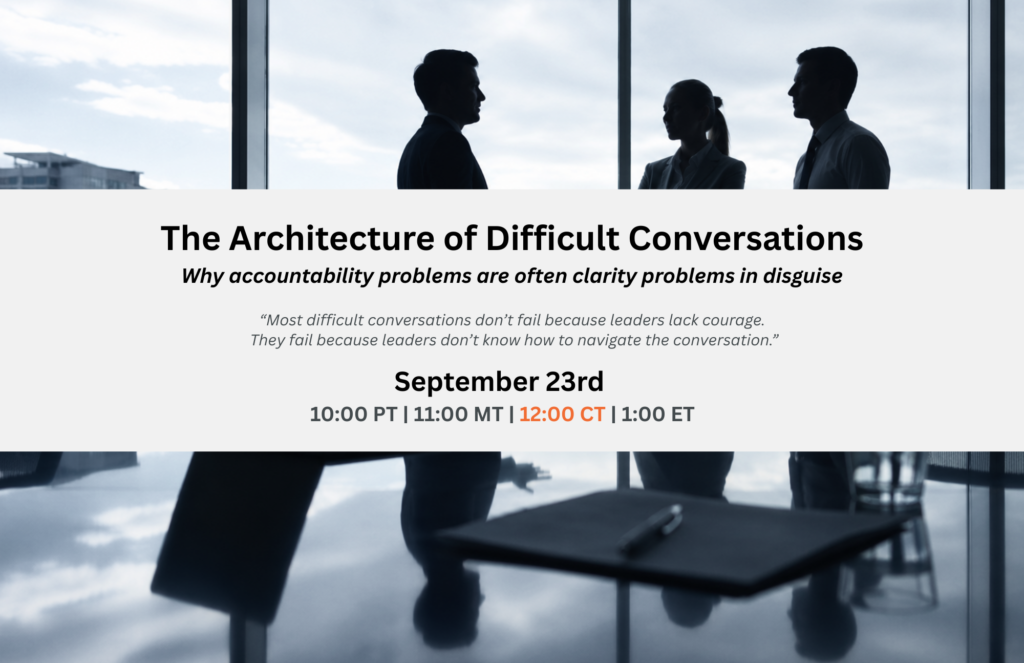
On September 23, I’m hosting a live webinar, The Architecture of Difficult Conversations.
You’ll learn how to:
- Recognize where conversations break down
- Understand the four-part conversation architecture
- Diagnose what is missing so you can choose your next move
- Distinguish accountability problems from leadership clarity problems
If you lead others, coach managers, or find yourself circling the same unresolved issue, I’d love to have you join me.